More brands are asking for dust bags that carry a sustainability story, and the fastest way to end up with a claim you cannot defend is to treat words like organic, recycled, and non-toxic as interchangeable. Each is governed by a specific textile certification with its own threshold and its own scope, and the labels do not overlap the way most buyers assume. Knowing what each one actually verifies lets you order a bag that backs up the message printed on it.
“Organic” is a threshold, not a mood
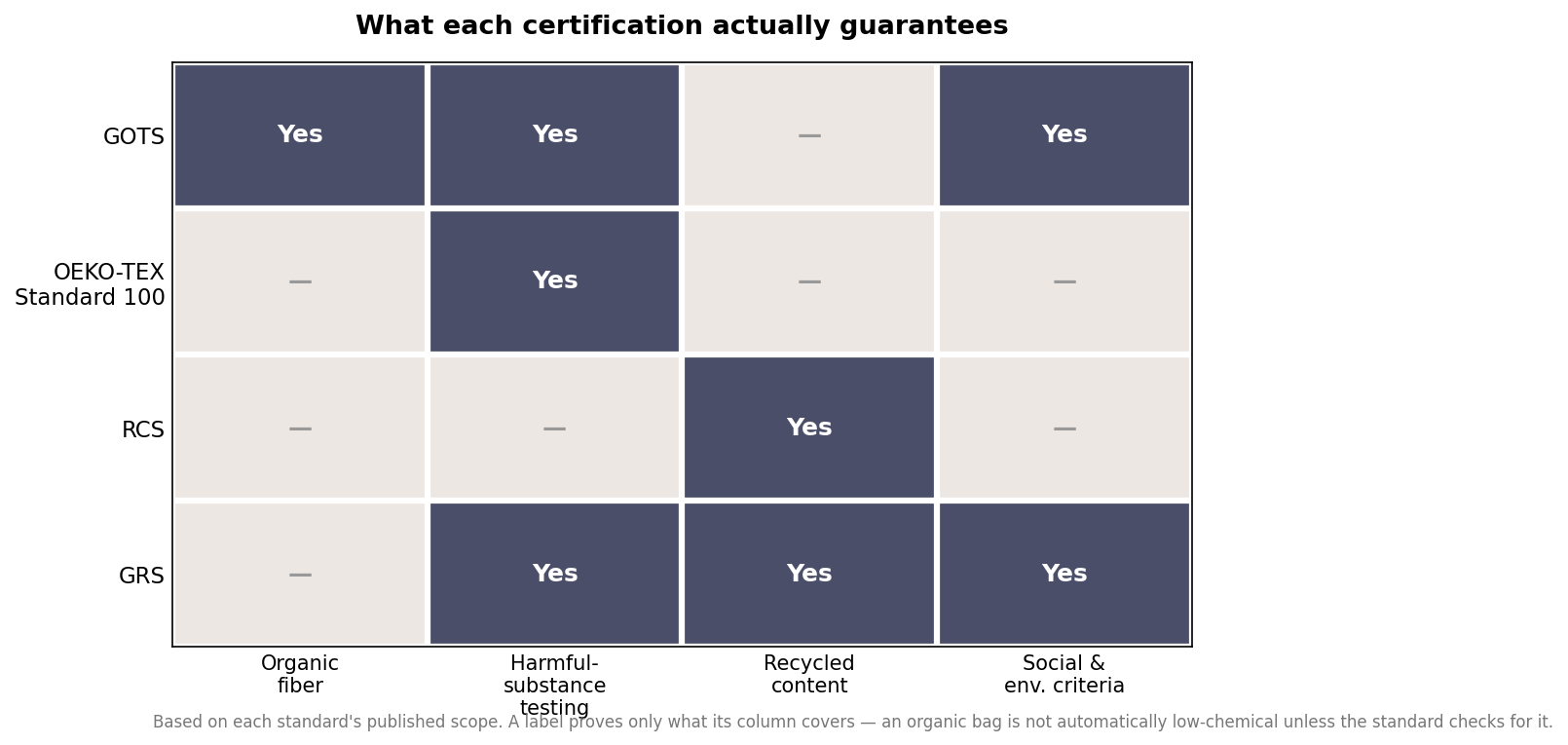
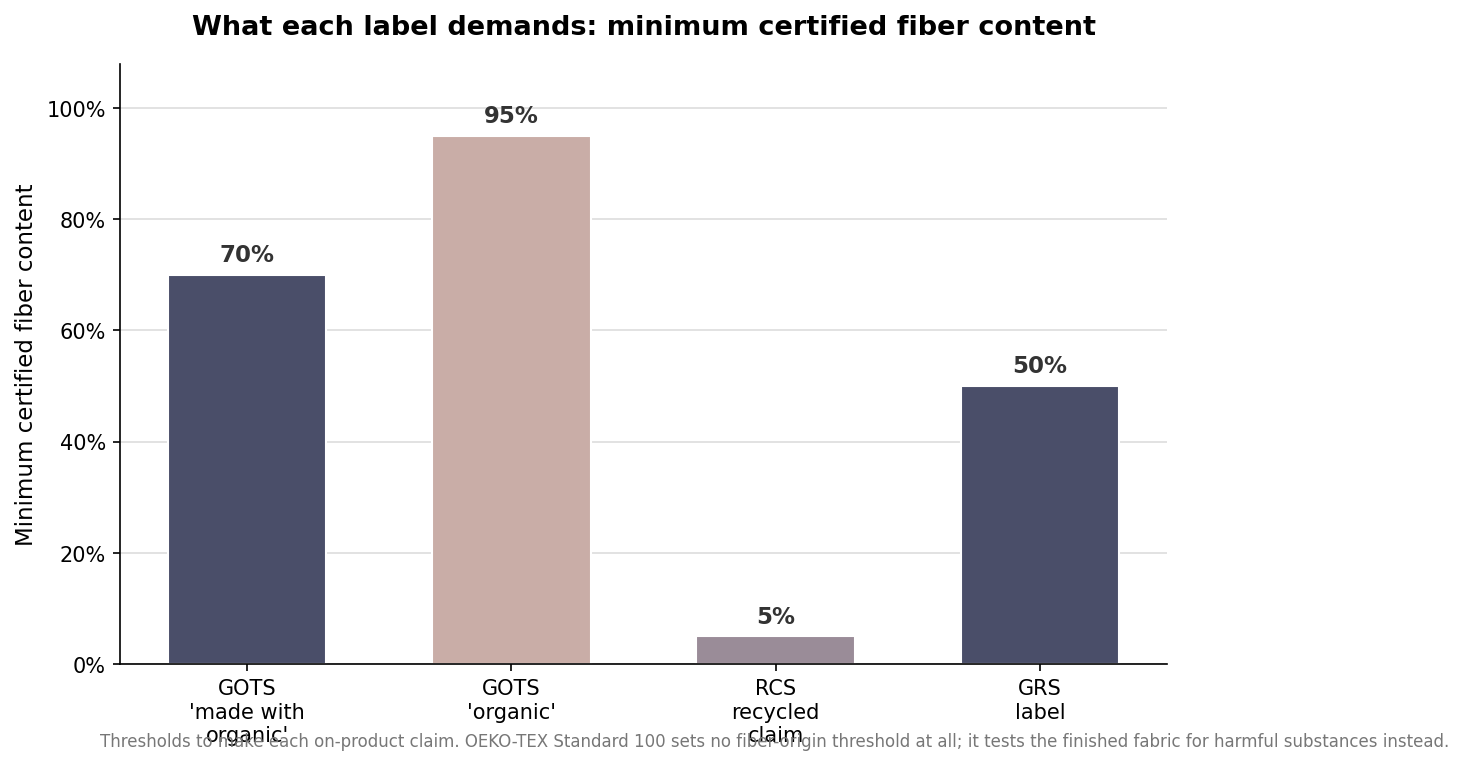
The recognized standard for organic textiles is GOTS, the Global Organic Textile Standard, and it draws a hard line at fiber content. A product needs a minimum of 70 percent certified organic natural fiber to be labeled “made with organic,” and at least 95 percent organic fiber to earn the stronger “organic” grade. A muslin dust bag described loosely as organic could sit anywhere along that range, so the grade matters.
GOTS also covers far more than the cotton field. It follows the material from the first processing step, through spinning, weaving, and wet processing, all the way to labeling, and along the way it bans or strictly restricts hazardous chemicals, requires wastewater treatment at wet-processing units, and applies social criteria aligned with International Labour Organization principles. That breadth is the reason GOTS certification costs more and takes longer to source, and it is also why a genuine GOTS bag is a meaningfully different product from an untested one that happens to use organic cotton.
OEKO-TEX tests safety, not origin
OEKO-TEX Standard 100 is the label buyers most often confuse with organic, and it answers a completely different question. It tests the finished fabric and its components for harmful substances, screening against limits for both regulated and non-regulated chemicals considered risky to human health, with Class I holding the strictest limits because it covers products for babies and toddlers. What it does not do is say anything about where the fiber came from. An OEKO-TEX label does not tell you the cotton is organic or that any polyester is recycled; it tells you the material tested clean for harmful substances. For a dust bag that will sit against a leather handbag or a pair of shoes for years, that safety testing is genuinely useful, but it is not an environmental origin claim and should not be marketed as one.
Because the two standards answer different questions, they stack rather than compete. A dust bag can be both GOTS certified and OEKO-TEX Standard 100 certified at the same time, which tells a customer that the cotton is organically grown and responsibly processed and that the finished fabric tested clean for harmful substances. If you want the fullest story on a natural-fiber bag, that pairing is the combination to ask your supplier for, provided each certificate is genuinely in place and documented rather than implied.
Recycled cotton and the RCS versus GRS split
Recycled content runs on two related standards from Textile Exchange, and the gap between them is wide. The Recycled Claim Standard (RCS) verifies that a stated share of recycled material is really present and tracks it through a certified chain of custody, and it can apply to a product with as little as 5 percent recycled content. It is a content-and-traceability check, nothing more. The Global Recycled Standard (GRS) is a full product standard: it requires a minimum of 50 percent recycled content to carry the GRS label, and on top of the content verification it adds chemical restrictions in processing and confirms that manufacturing sites meet social and environmental requirements.
There is also a physical reality worth setting expectations around. Mechanically recycled cotton has shorter fiber staples than virgin cotton, which lowers yarn strength, so recycled cotton is usually blended with virgin fiber rather than used at 100 percent. A recycled-content dust bag is a legitimate sustainability choice, but a very high recycled percentage in a thin drawstring bag can mean a weaker, linty cloth, and the honest move is to balance recycled content against the durability the bag needs to do its job.
Choosing the right certification for the claim you want to make
Start from the sentence you want to print or tell customers. If the message is about organic farming and clean, ethical processing, GOTS is the standard that backs it, and you should specify whether you are buying the 70 percent or the 95 percent grade. If the message is simply that the bag is safe and free of harmful substances, OEKO-TEX Standard 100 is the right and sufficient proof, and it pairs well with either organic or recycled fiber. If the story is about diverting waste, RCS lets you state a verified recycled percentage, while GRS is the stronger claim that also speaks to chemistry and factory conditions.
Two practical cautions close the loop. First, certification travels with paperwork: to make a certified claim on your finished dust bags, your supplier and their mill need valid scope certificates and transaction certificates, not just a verbal assurance that the cotton is organic. Second, do not stack claims a single label does not support. An organic bag is not automatically low-chemical unless the standard checks for it, and a recycled bag is not automatically safe against harmful substances unless it was tested. Match one clear claim to the one certification that actually verifies it, confirm the documents, and the sustainability line on your dust bag becomes something you can stand behind.
Leave a Reply