A dust bag looks like a simple drawstring sack, but the fabric it is cut from is doing quiet, specific work. Choose well and the bag shields a product for years; choose poorly and the same bag can trap moisture against leather or let dust settle straight through a thin weave. If you are ordering custom dust bags for a brand, the fabric decision is the one that determines whether the bag protects or just decorates.
What a dust bag is actually protecting against
The threats to a stored handbag, shoe, or piece of jewelry are unglamorous and constant. Dust settles on surfaces and works into grain and stitching. Ultraviolet light fades dyes and yellows pale leathers. Loose dye from a neighboring garment transfers onto a lighter item. And humidity, the quietest of the four, encourages mildew and can leave metal hardware tarnished. A good cotton cover is the first line of defense against all of these: it keeps dust and light off the item while letting the material underneath breathe.
The most common mistake is reaching for plastic instead. A polybag or an airtight bin feels protective, but it seals moisture in. Leather naturally breathes, and when it cannot, trapped humidity can lead to sticky finishes, surface cracking, and mold. The storage rule that follows from this is simple: never seal a leather item inside plastic, stuff it with acid-free tissue to hold its shape, stand it upright rather than hanging it by the straps, and keep it in a cool, dark, ventilated spot inside a breathable bag.
Why breathability beats a sealed barrier
Breathability is the whole point of using fabric. Woven cotton lets air move through the weave, so any moisture that reaches the item can escape rather than condense against it. That single property is why the luxury industry standardized on cotton covers rather than the cheaper plastic sleeves that a sealed product might otherwise ship in. The bag is not trying to be waterproof; it is trying to be a filter that stops particles and light while staying permeable to air.
This is also why fabric weight and weave matter more than they first appear. Too open and loose, and fine dust passes through. Too dense or synthetic, and you start losing the airflow that made the cotton worth choosing. The right dust bag fabric sits in the middle: tight enough to block particulates and give opacity against light, open enough to keep breathing.
Fabric weight, and what it buys you
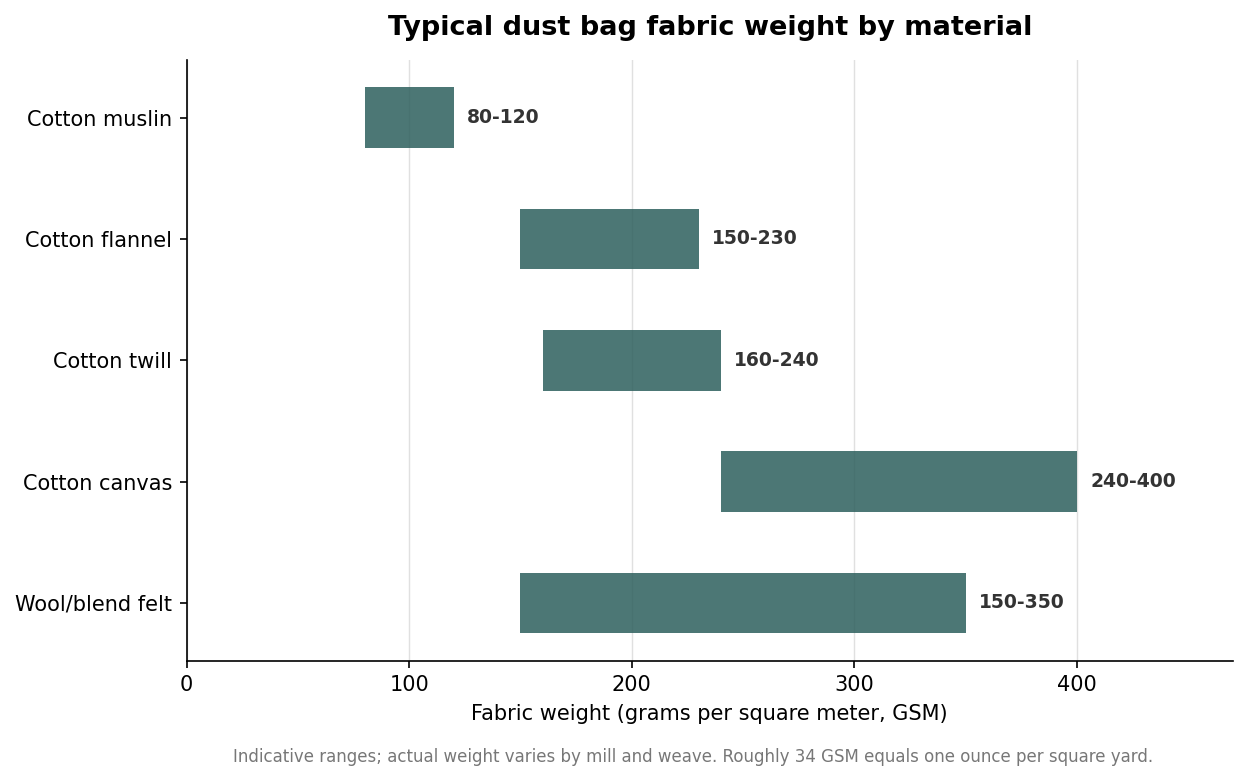
Fabric weight is measured in grams per square meter, or GSM, and it is the most useful single number to specify. Lightweight cotton muslin, in the rough range of 80 to 120 GSM, is thin, inexpensive, and fine for low-cost or promotional covers where the bag is more presentation than protection. Cotton twill and brushed flannel sit heavier, commonly around 150 to 240 GSM, with enough body to feel substantial and enough opacity to genuinely shield against light. Cotton canvas is heavier still, often 240 to 400 GSM, and reads as premium in the hand. As a rough conversion, about 34 GSM equals one ounce per square yard, so a 240 GSM twill is roughly a seven-ounce fabric.
Heavier is not automatically better; it is a trade-off. More weight buys opacity, structure, and a more luxurious feel, but it also costs more per bag and adds shipping weight across a large order. The relationship is close to linear: as fabric weight climbs, so does unit cost. For a value line you may want the lightest fabric that still does the job, while a flagship product can justify a heavier twill or canvas that signals quality the moment a customer lifts it.
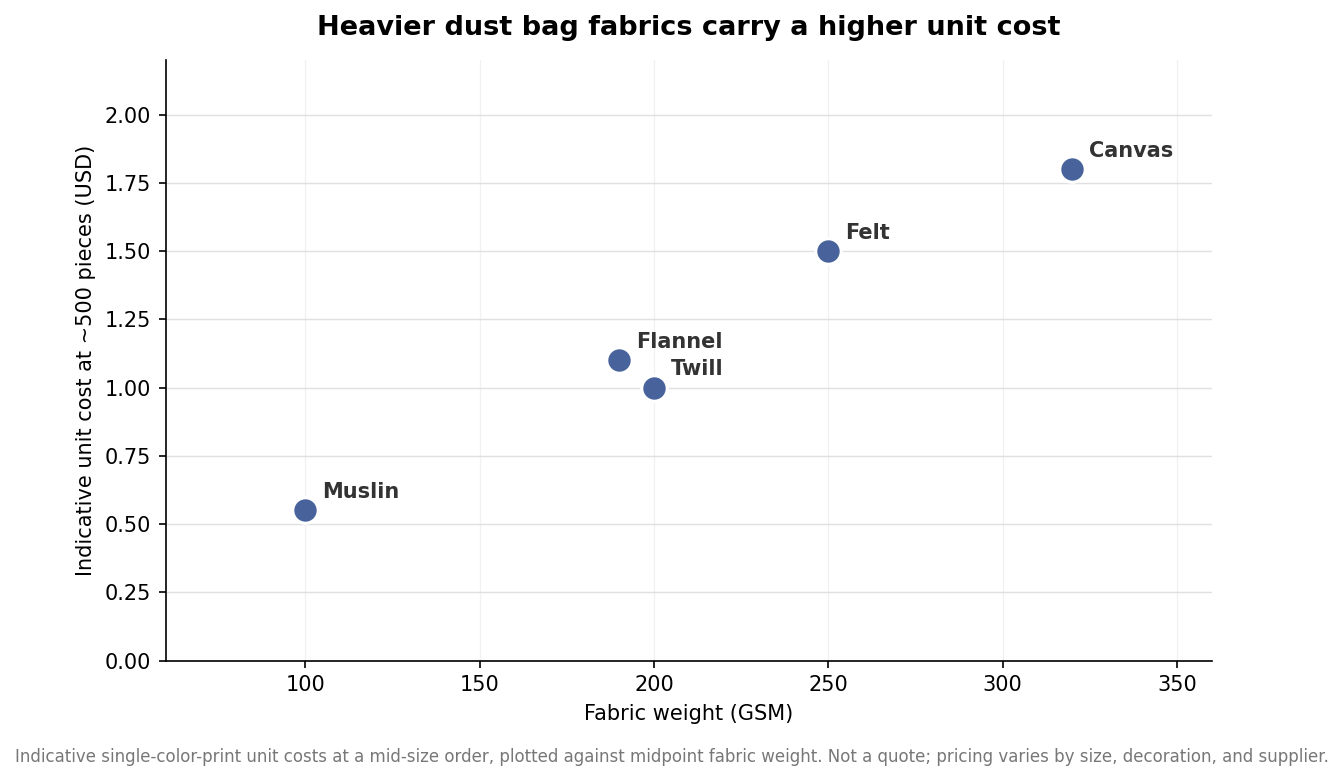
Those unit costs are indicative single-color-print figures at a mid-size order, not quotes, and they move with bag size, decoration, and supplier. Minimum order quantities for custom dust bags commonly start somewhere around a hundred to a few hundred pieces per size, so it is worth settling on fabric and dimensions before you request pricing.
Flannel, felt, and the metal problem
Metal changes the calculation. Silver and many plated finishes tarnish when exposed to sulfur compounds in ordinary air, and a plain cotton bag does little to slow that. This is where brushed flannel and felt earn their place. A soft, napped flannel cushions against scratching, which matters for polished jewelry and watches, and anti-tarnish treated fabrics go a step further by actively absorbing the airborne sulfur that would otherwise dull the metal. Felt brings structure and padding, making it a common choice for hard goods, watch rolls, and eyewear where a little cushioning protects against knocks.
For a jewelry or accessories brand, this points to a different fabric than a handbag label would choose. A napped or anti-tarnish interior does protective work that a flat muslin simply cannot, and it is worth specifying deliberately rather than defaulting to the lightest cotton because it prints cleanly.
Choosing the fabric for the product
Match the fabric to what it will hold. For leather handbags, a mid-weight breathable cotton twill is the reliable default: enough opacity and body to protect, without the airflow penalty of a synthetic. For shoes and delicate uppers, a soft flannel or a lightly napped cotton avoids scuffing the surface it wraps. For jewelry, watches, and silver, choose flannel or an anti-tarnish fabric, and add felt where cushioning helps. For promotional or budget covers, lightweight muslin or a non-woven keeps unit costs down where deep protection is not the goal. And for a premium unboxing moment, a heavier twill or canvas, or a satin exterior over a breathable lining, delivers the feel customers associate with a considered brand, with the caveat that pure satin is less breathable and better suited to short-term presentation than long-term storage.
Specify two things on every order and the bag will do its job: the fabric by name and the weight in GSM. Those two figures, more than color or logo placement, decide whether the dust bag protects the product or merely wraps it.
Leave a Reply