If you’re about to place your first order for custom dust bags, the quotes you get back can swing wildly from one supplier to the next — anywhere from a quarter to nearly ten dollars a piece. That’s not a scam. It reflects real differences in fabric, order size, and how much branding you’re asking a factory to apply. Custom dust bags protect handbags, shoes, and other soft goods during shipping and storage, and for a lot of small brands they’re also the first thing a customer touches when a package arrives, which makes the material and print quality matter more than it might seem.
Before you send a deposit, it helps to know what a fair price, a normal minimum order quantity, and a realistic lead time actually look like. This guide walks through current wholesale pricing by material, the MOQ tiers most factories quote at, production timelines, and the sizing math suppliers use to fit bags to products — so you can tell a fair quote from an inflated one.
Source: Aggregated wholesale supplier listings on Alibaba.com and Made-in-China.com, accessed August 2026
How much do custom dust bags cost?
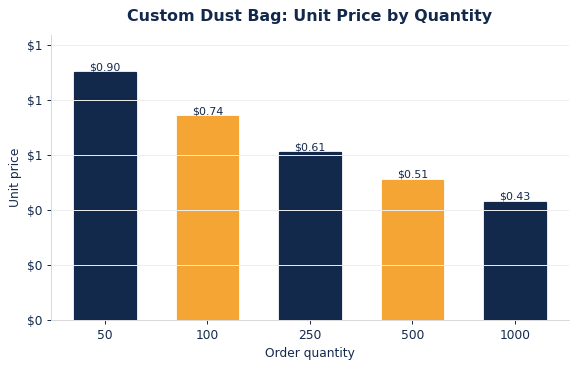
Price per piece is driven mainly by three things: the fabric, the order quantity, and how the logo gets applied. A plain non-woven polypropylene bag with a single-color screen-printed logo is the cheapest option on the market. A heavyweight cotton or canvas bag costs more because the raw material itself is pricier and it takes longer to sew. Velvet sits in an odd middle spot — the fabric is inexpensive in bulk, but the finishing techniques usually paired with it (gold foil stamping, debossing, satin ribbon drawstrings) push the finished price up fast.
The table below reflects current wholesale listings for custom dust bags across the major manufacturing categories. Treat these as ballpark figures for planning a budget, not a firm quote — every factory prices tooling, art setup, and rush fees differently.
| Material | Price per piece (bulk) | Typical MOQ |
|---|---|---|
| Non-woven polypropylene | $0.25 – $0.50 | 1,000 pcs |
| Cotton / canvas (standard weight) | $0.95 – $1.20 | 1,000 pcs |
| Cotton / canvas (lighter weight, smaller run) | $0.41 – $0.60 | 500 pcs |
| Velvet, plain | $0.08 – $0.15 | 500 – 1,000 pcs |
| Fully branded luxury (foil stamp, embroidery) | $8.50 – $9.90 | 100 – 500 pcs |
Choosing your material: non-woven, cotton, canvas, or velvet
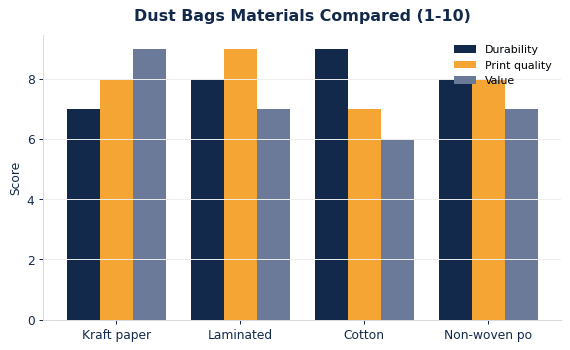
Material choice comes down to what the bag is protecting and how it’s used after the sale. A bag that gets shipped once and stuffed in a closet doesn’t need the same fabric as one your customer will reuse as travel packaging for years.
Non-woven and cotton: the everyday options
Non-woven fabric — the same spun-bond material used in reusable grocery totes — is the budget default for high-volume shipping. It’s dust-resistant, holds a printed logo well, and keeps unit cost low, which is why it dominates orders above a few thousand pieces. Cotton and canvas cost more but feel and look better: the weave breathes, which matters for leather goods that can trap moisture and develop odor or mildew in a sealed plastic-feeling bag. Cotton is also easier to reprint or resize in small custom runs, since factories that sew garments often run the same lines.
Velvet and satin: when you want retail polish
Velvet and satin dust bags are the ones customers keep. The fabric itself is cheap in bulk, but brands typically pair it with a drawstring cord, a debossed or foil-stamped logo, and sometimes a satin lining — each of those adds a line item to the quote. Velvet also shows scuffs and crushing on the pile over time, so it suits lower-volume, higher-margin products like jewelry, watches, or premium handbags better than it suits everyday shoe packaging.
MOQs and lead times: what to expect
Minimum order quantities vary more by factory size than by product complexity. Small workshops that specialize in custom runs will often take an order as low as 100 pieces for a single-color print, and some marketplace sellers list quantities as low as 10 for pre-existing stock designs with your logo added. Larger factories that buy fabric by the roll usually set a 1,000-to-2,000-piece floor per color and size combination — and that MOQ typically applies per variant, not per order, so three colors in two sizes can mean six separate minimums stacked together.
Lead time is where new buyers get caught off guard. Bulk production commonly runs 15 to 25 days once artwork is approved, with some factories quoting 25 to 30 working days for larger or more detailed orders. That clock doesn’t start until you’ve signed off on a physical or digital proof, and a sampling round before that can add another one to two weeks. If you’re ordering for a launch date, work backward from that date and budget at least five to six weeks total for sampling plus bulk production plus shipping.
Getting sizing right for your product
Suppliers generally bucket custom dust bags into three size bands rather than offering fully custom dimensions at low quantities, since custom sizing usually requires its own pattern and adds to both cost and MOQ. The trick to picking the right band is measuring your product’s longest dimensions and adding clearance so the bag closes above the item without straining the drawstring.
| Size | Dimensions | Best for |
|---|---|---|
| Small | 10″ x 12″ | Single shoe, clutch, small crossbody bag |
| Medium | 14″ x 16″ to 14″ x 18″ | Boots, pairs of flats or heels, medium handbags |
| Large | 18″ x 20″ to 25″ x 25″ | Totes, weekenders, coats, oversized bags |
Printing and branding options
How you apply the logo affects both price and durability, and it’s worth matching the method to the fabric rather than defaulting to whatever’s cheapest. Screen printing is the standard for non-woven and cotton bags — it’s inexpensive per color but each additional color adds a setup charge and a bit to the per-piece cost. Embroidery holds up best over years of reuse and reads as more premium, but it only works cleanly on woven fabrics like cotton, canvas, or velvet, not on thin non-woven material. Foil stamping and debossing are the finishes you see on velvet and satin luxury bags; they look sharp but require a metal die, which is a one-time tooling cost worth asking about upfront since it’s sometimes billed separately from the per-piece price.
If you’re ordering across a few different bag sizes for the same collection, ask whether the factory can reuse one screen or die across all of them — it’s a simple way to cut setup costs without cutting corners on the finished product.
Placing your first order: A checklist
A few steps before you commit money will save you from the two most common mistakes: ordering the wrong size and getting stuck with a color that looked different on screen.
- Measure your product’s longest edge and pick a size band with 1–2 inches of clearance.
- Request a physical sample in your chosen material and color before approving bulk production — screens and photos misrepresent fabric weight and true color more often than not.
- Confirm whether the quoted MOQ applies per color/size variant or across your whole order.
- Get lead time in writing as a range, and ask what happens to that range if you request changes after the proof is approved.
- Ask if setup or tooling fees (screens, embroidery digitizing, foil dies) are one-time or charged per reorder — reordering the same design later should usually be cheaper and faster than the first run.
Frequently asked questions
What’s the minimum order quantity for custom dust bags?
It depends heavily on the supplier. Small workshops and marketplace sellers often accept orders as low as 100 pieces, sometimes fewer for pre-existing stock designs. Larger factories that cut fabric from rolls typically set a floor of 1,000 to 2,000 pieces per color and size combination.
How long does it take to get custom dust bags made?
Bulk production usually takes 15 to 25 days once you’ve approved a proof, with some suppliers quoting up to 30 working days for larger or more detailed orders. Add another one to two weeks if you’re ordering a physical sample first, which is worth doing before committing to a full run.
Which material is best for shoes versus handbags?
Cotton or canvas is a solid default for both — it breathes, which helps prevent moisture buildup on leather. Non-woven fabric is fine for shoes shipped in a box that won’t sit in storage long-term. Velvet is better reserved for handbags or accessories where the bag itself is part of the retail presentation.
Do I need to order a sample before placing a bulk order?
Yes. Fabric weight, color accuracy, and print quality are hard to judge from a spec sheet or product photo. A sample round adds time upfront but is far cheaper than discovering a color or material mismatch after 1,000 units have already shipped.
How much should I budget per bag?
For a simple one-color logo on non-woven fabric at 1,000 pieces, budget roughly $0.25–$0.50 per bag. Cotton or canvas at the same volume runs closer to $0.95–$1.20 per bag. Heavily branded velvet or satin bags with foil stamping or embroidery can run several dollars per piece, so get a quote before assuming a premium finish fits a small-batch budget.
The bottom line
The spread in what people pay for custom dust bags almost always comes down to fabric, quantity, and finishing — not one supplier being dishonest and another being fair. Once you know a plain non-woven bag should land under fifty cents a piece at volume, that cotton costs roughly double, and that a real lead time runs three to four weeks after art approval, you’re in a much stronger position to spot a quote that’s out of line. Measure your product, request a sample, and confirm the MOQ terms in writing before you commit to a bulk run.