Author: George

  • Custom Dust Bags: Materials, Sizing & Branding Guide

    Custom Dust Bags: Materials, Sizing & Branding Guide

    Custom Dust Bags: A Materials, Sizing, and Branding Guide

    Getting custom dust bags right comes down to three decisions: the material, the size or spec, and how you brand them. Make those well and you end up with custom dust bags that protect and present your product, reinforce your brand, and land on budget. This guide walks through the material options, how to size and spec your order, and how to decorate custom dust bags so they do real work for your brand rather than just checking a box.

    Whether you are ordering your first run or reordering at scale, the same fundamentals apply. Choosing custom dust bags deliberately — material to job, size to product, decoration to brand — is what separates an order you are proud of from one you settle for.

    Why custom dust bags matter for your brand

    Custom dust bags are more than a commodity; they are a touchpoint brands experience directly. A well-chosen, well-branded option signals quality and attention to detail, while a generic one quietly undercuts an otherwise strong product. Because custom dust bags are seen and handled, they carry your brand into the world every time they are used.

    That visibility is exactly why it pays to spec custom dust bags intentionally. The material sets the feel, the size sets the fit and cost, and the decoration sets the impression — and getting all three aligned turns a functional item into a genuine brand asset.

    Materials and options compared

    The common materials for custom dust bags each trade off durability, print quality, and cost: kraft paper, laminated / matte film, cotton / canvas, and non-woven polypropylene. The right pick depends on how the dust bags will be used, the look you want, and your budget. The chart and table below compare the main options so you can match material to job.
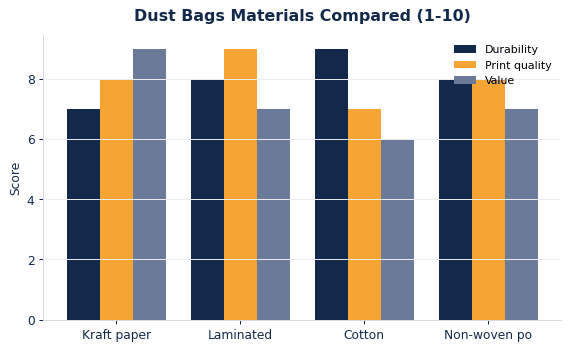
    How common dust bags materials compare on durability, print quality, and value.
    How common dust bags materials compare on durability, print quality, and value.

    As a rule of thumb, choose a recyclable or natural material when eco positioning matters, a coated or laminated option when you want vivid full-color print, and a premium build when the dust bags is part of a gift or high-end presentation. When in doubt, request a sample so you can judge feel and print before committing to a full run.

    Material / option Best for
    Kraft paper recyclable and natural, ideal for eco positioning
    Laminated / matte film durable, moisture-resistant, premium finish
    Cotton / canvas reusable and sturdy for a keepsake feel
    Non-woven polypropylene low-cost, reusable, lightweight

    Sizing and specs

    Sizing is where many dust bags orders go wrong, so measure before you order. Custom dust bags typically range from a slim gift bag up to a wide gusseted grocery or retail bag, and the right size and gusset depends on the product or use they serve. Too small and the fit is tight or the product is exposed; too large and you pay for material you do not need and lose a clean, intentional look.

    When a measurement falls between standard options, size to the product with a small margin rather than guessing. Confirming the size and gusset on a proof or sample before a large run prevents the costly mistake of a full order that does not fit, which is far more expensive to fix than a five-minute check up front.

    Branding and decoration

    Decoration is what turns a plain dust bags into a branded one. Screen printing suits bold one- or two-color logos, while full-color printing wraps detailed art edge to edge. Match the method to your artwork and budget: simple logos reproduce cleanly and cheaply, while detailed, full-color designs shine with the right process on the right material. Keep the artwork vector where possible and confirm the print area for your chosen size.

    Restraint usually reads as premium. A clean logo, one or two brand colors, and quality material almost always look more considered than a busy, over-printed design. Approving a proof before the run protects both the look and the budget, especially on a large order of custom dust bags.

    Ordering and budget

    Per-unit cost on custom dust bags falls steadily with volume as setup amortizes across more pieces, so ordering for real demand rather than a token first batch is usually the efficient move. The curve below shows how pricing typically improves with quantity, which helps you plan an order that balances cash and cost.
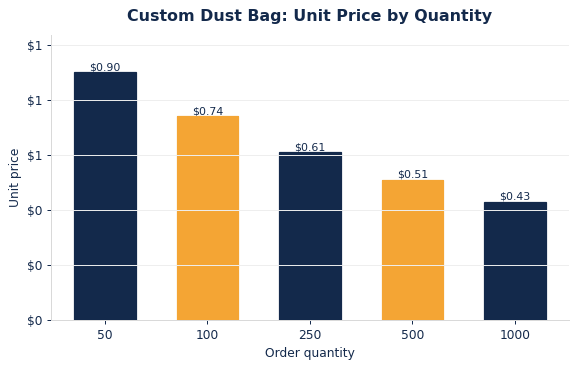
    Typical per-unit dust bags pricing as order quantity increases.
    Typical per-unit dust bags pricing as order quantity increases.
    Ordering for a recurring need? A single larger run lowers the unit cost and keeps your branding consistent, while a small overage covers reorders and the occasional damaged piece without a rush order.

    Common mistakes to avoid

    A few avoidable missteps account for most disappointing dust bags orders. Ordering before measuring is the biggest, followed by choosing a material for price alone without considering how the dust bags will actually be used, and skipping the proof on a large run. Each is easy to prevent with a few minutes of planning, and each is expensive to fix once a full order is produced.

    The other common trap is over-designing the artwork. Cramming in too many colors, effects, or details can muddy the print and raise the cost, especially on textured or recycled materials. Simplifying the design to a clean, legible mark almost always improves both the look and the price of your custom dust bags.

    Frequently asked questions about custom dust bags

    What material is best for custom dust bags?

    It depends on the use: choose a recyclable or natural material for eco positioning, a coated or laminated option for vivid full-color print, and a premium build for gifting or high-end presentation. Request a sample to judge feel and print before a full run of custom dust bags.

    How do I choose the right size?

    Measure the product or use the dust bags serves, then size to it with a small margin so the fit is clean without wasting material. When a measurement falls between standard options, size up slightly and confirm the size and gusset on a proof before ordering in volume.

    How are custom dust bags branded?

    Screen printing suits bold one- or two-color logos, while full-color printing wraps detailed art edge to edge. Match the method to your artwork and budget, keep the art vector where possible, confirm the print area for your size, and approve a proof so the finished custom dust bags match your intent.

    How does pricing work, and is there a minimum?

    Per-unit cost drops with quantity as setup amortizes across the run, so larger orders are more cost-effective. Order for real demand plus a small overage rather than a token batch, and consolidate recurring needs into one run for the best price.

    Can I get a sample or proof before ordering?

    Yes, and it is strongly recommended. A physical sample lets you judge material and print, and a digital or physical proof confirms your artwork, color, and size and gusset before a full run — a small step that prevents a costly mistake on a large order.

    What do you need to quote custom dust bags?

    To quote accurately we need the size and gusset or the product they serve, the quantity, your material preference, and your artwork or a description of the branding. With those details we can recommend the right material and size and give you pricing for the run, and a proof follows once the order is confirmed.

    Whatever you order, send vector artwork, confirm material and size and gusset, and approve a proof before production. For help matching custom dust bags to a specific use, see our companion guide, our How to Choose Custom Dust Bags for Your Brand, and explore our our shop to start your order.

    Ready to order custom dust bags?

    Tell us your product, quantity, and branding and we’ll match the material, size, and decoration for you.

    Get a Quote

  • How Many Dust Bags Should You Order?

    Call or Text us: (929) 605-4397

    Home › Blog › How Many Dust Bags Should You Order?

    Ordering

    How Many Dust Bags Should You Order?

    06/12/2026

    Deciding how many custom dust bags to order is the first question every buyer hits β€” and getting it roughly right saves both money and warehouse space. Order too few and your next production run sells out before the bags arrive; order too many and they sit in storage tying up cash.

    Here’s the practical framework we walk every customer through, from a first collection launch to a full retail rollout.

    Start with your unit volume

    The cleanest starting point is how many individual units β€” handbags, shoes, jewelry pieces β€” you expect to sell or ship over the bag’s useful life. If you bag every unit that leaves the warehouse, your dust bag order should roughly match your production or inventory run for that period, plus a small buffer for damaged goods and samples.

    Match quantity to the goal

    A bag-every-unit program needs full coverage of your SKU volume; a gift-with-purchase or wedding-favor program only needs to match expected attendance or a defined promotional run.

    ScenarioTypical quantityBest style
    New brand / capsule launch100–500Cotton Drawstring
    Wedding favors75–300Satin
    Jewelry / watch line250–1,000Felt
    Full retail rollout5,000–25,000+Non-Woven or Cotton
    Handbag / luggage brand500–5,000Large Dust Bag

    Choosing for your order

    When in doubt, round up to the next price break β€” the per-unit cost usually drops enough at the next tier that the extra units are nearly free, and leftover dust bags keep for future inventory or a future gift-with-purchase promotion.

    Key takeawayFor bag-every-unit programs, order to match production volume plus a 5–10% buffer. For favors and gifting, order to match expected attendance or your promotional run.

    Ready to put your brand on every bag? Get a custom quote β€” free mockups in 24–48 hours. Learn more about how we work, or browse more guides.

    More posts

  • Cotton vs. Flannel vs. Felt Dust Bags: Which to Choose

    Call or Text us: (929) 605-4397

    Home › Blog › Cotton vs. Flannel vs. Felt Dust Bags

    Buyer guides

    Cotton vs. Flannel vs. Felt Dust Bags: Which to Choose

    06/05/2026

    Fabric is the single biggest decision on a dust bag order β€” it drives cost, feel, and how well the bag protects what’s inside. Cotton, flannel, and felt are our three most-ordered fabrics, and each one is genuinely better suited to a different job.

    Cotton: the reliable everyday choice

    Cotton twill is durable, affordable at volume, and prints cleanly. It’s the right default for handbags, larger accessories, and any product where the bag needs to handle regular in-and-out use without showing wear. If you’re not sure which fabric to pick, cotton is almost always the safe answer.

    Flannel: the soft-touch upgrade

    Brushed flannel has a noticeably softer hand than plain cotton, and that texture reads as a small luxury the moment a customer touches it. It costs a little more than standard cotton but less than felt, which makes it a popular middle-tier upgrade for brands moving from a purely functional bag to one that feels like part of the product experience.

    Felt: structure and protection in a small footprint

    Felt doesn’t fray, holds a defined shape, and cushions better than a loose weave β€” which is exactly what small, high-value items like jewelry and watches need. It’s not the fabric to choose for a large tote bag; it’s the fabric to choose when the product inside is small and easily scratched.

    FabricFeelBest forRelative cost
    CottonSturdy, matteHandbags, general accessories$
    FlannelSoft, brushedPremium accessories, gift-with-purchase$$
    FeltStructured, denseJewelry, watches, small goods$$

    Choosing for your order

    If your product is large and gets handled often, choose cotton. If you want a soft-touch upgrade without a big cost jump, choose flannel. If your product is small and needs real structure and scratch protection, choose felt.

    Key takeawayCotton for durability and value, flannel for a soft premium feel, felt for structure and small-item protection.

    Not sure which fits your product? Get a custom quote and we’ll recommend a fabric. Learn more about how we work, or browse more guides.

    More posts

  • Dust Bags as Retail Packaging: The Overlooked Margin Booster

    Call or Text us: (929) 605-4397

    Home › Blog › Dust Bags as Retail Packaging

    Retail

    Dust Bags as Retail Packaging: The Overlooked Margin Booster

    05/22/2026

    Most retailers default to a plain poly mailer or a generic paper bag at checkout because it’s cheap and easy. But at scale, the cost difference between a blank bag and a branded custom dust bag is often just a few cents per unit β€” and what you get back in perceived value and repeat purchase can be worth far more than that gap.

    The impressions-per-dollar math

    A dust bag isn’t single-use packaging that gets thrown away with the shipping box. Customers reuse dust bags to store shoes, protect handbags, and organize travel gear β€” which means your logo stays in front of the customer, in their closet, long after the sale. Very few packaging touches keep working for you months or years after checkout.

    Perceived value at the register

    Handing a customer a branded fabric bag instead of a plastic mailer changes how the entire purchase feels. It signals that the brand thought about the experience beyond the product itself β€” which is exactly the signal boutiques and specialty retailers are trying to send with every touchpoint.

    Where the margin comes from

    At non-woven or cotton volume pricing, a custom dust bag typically lands in the same range as a decent branded poly mailer, but customers do not keep a poly mailer. The dust bag’s reuse value effectively extends your marketing spend for free, which is the actual margin booster β€” not a lower unit cost, but a higher return on the packaging dollar you were already spending.

    Key takeawayA branded dust bag costs about the same as decent branded packaging but keeps working as free, reusable marketing long after the sale.

    Ready to upgrade your packaging? Get a custom quote β€” free mockups in 24–48 hours. Learn more about how we work, or browse more guides.

    More posts

  • Custom Dust Bags for Handbag & Footwear Brands

    Call or Text us: (929) 605-4397

    Home › Blog › Custom Dust Bags for Handbag & Footwear Brands

    Handbag brands

    Custom Dust Bags for Handbag & Footwear Brands

    05/08/2026

    For handbag and footwear brands, the dust bag is doing two jobs at once: protecting a finished product from dust, light, and scuffs, and functioning as a piece of branded packaging the customer sees and touches at the exact moment of purchase. Getting both right is worth the extra attention most brands skip past.

    Protection comes first

    Leather, suede, and finished textiles are all vulnerable to surface scuffs and color transfer when items rub together in storage or a shipping box. A properly sized dust bag β€” not too tight, not so loose it slides around β€” is the cheapest insurance a brand can add to every unit that ships.

    Sizing for the actual product

    The single most common mistake we see is ordering a size that’s technically “close enough.” A bag that’s too small stresses the seams and won’t close; one that’s too large lets the product shift and doesn’t look intentional in photos. We size every order to the actual product dimensions, with a little room to fold or cinch closed cleanly.

    Fabric choice by product tier

    Entry-level and mid-tier lines typically do well on standard cotton, which balances durability and cost. Premium and limited-edition lines often move to flannel for the softer feel, or to our Large Dust Bag style specifically sized for totes, duffels, and oversized footwear boxes.

    Key takeawaySize the bag to the actual product, and match fabric tier to product tier β€” cotton for everyday lines, flannel or large-format for premium and oversized goods.

    Building out a new line? Get a custom quote and send us your product dimensions for a sizing recommendation. Learn more about how we work, or browse more guides.

    More posts

  • Dust Bag Sizes: Small, Medium, and Large Compared

    Call or Text us: (929) 605-4397

    Home › Blog › Dust Bag Sizes: Small, Medium, and Large Compared

    Buyer guides

    Dust Bag Sizes: Small, Medium, and Large Compared

    04/24/2026

    Dust bags range from a 3-inch jewelry pouch to a 28-inch bag built for a weekender duffel, and choosing the right size is mostly a matter of matching the bag to the product it needs to protect β€” with a little room to spare for a clean, secure closure.

    Small (3–8 in): jewelry, watches, small accessories

    Small bags are almost always felt or satin, since both hold a defined shape at a compact scale and add a sense of occasion to a small gift. Print area is limited, so a small logo mark works better than a full wordmark at this size.

    Medium (8–16 in): shoes, wallets, mid-size accessories

    This is the most common size range, and where cotton, flannel, and non-woven fabrics all perform well. A medium bag comfortably fits a shoebox insert, a mid-size handbag, or a folded stack of apparel, and gives enough surface area for a full logo or wordmark print.

    Large (16–34 in): handbags, luggage, bulky goods

    Large bags need reinforced seams and a longer drawstring β€” or a dual-cord closure β€” to cinch fully around an oversized shape. This is our Large Dust Bag style, and it’s the right call whenever a standard bag won’t close around the product without straining.

    Size rangeTypical productCommon fabric
    3–8 inJewelry, watchesFelt, Satin
    8–16 inShoes, wallets, mid-size accessoriesCotton, Flannel, Non-Woven
    16–34 inHandbags, luggage, bulky goodsLarge Dust Bag (Cotton or Non-Woven)

    Choosing for your order

    When your line spans multiple product sizes, it’s common to order two or three sizes in the same fabric and color for a consistent look across the whole catalog.

    Key takeawayMatch the bag size to the actual product, with a little room to fold or cinch closed β€” not to the nearest “standard” size.

    Not sure what size fits your product? Get a custom quote and send us your dimensions. Learn more about how we work, or browse more guides.

    More posts

  • How to Order Custom Dust Bags: A Step-by-Step Checklist

    Call or Text us: (929) 605-4397

    Home › Blog › How to Order Custom Dust Bags

    Ordering

    How to Order Custom Dust Bags: A Step-by-Step Checklist

    04/10/2026

    Ordering custom dust bags for the first time is straightforward once you know what to have ready. Here’s the exact checklist we walk customers through, from first quote to delivered order.

    1. Gather your basics

    Before you request a quote, have your brand name, a logo file (vector if you have one), your target quantity, and the dimensions of the product the bag needs to hold. Approximate numbers are fine β€” we’ll firm everything up during the mockup stage.

    2. Pick a fabric and color

    If you’re not sure, tell us what the bag is protecting and we’ll recommend one β€” cotton and flannel for handbags and accessories, felt for jewelry and watches, satin for gifting and favors, non-woven for high-volume retail rollouts.

    3. Request your quote

    Submit the details through our quote form. We reply within one business day with a photo-real mockup showing your logo on the actual bag, along with bulk pricing for your quantity.

    4. Revise until it’s right

    Mockup revisions are free and unlimited. Adjust logo placement, size, or color as many times as you need before signing off.

    5. Approve and pay

    Once you approve the final mockup, we lock the design and begin production the same day.

    6. Track and receive

    Standard production ships in about 2 weeks, with tracking provided. Rush production is available for firm deadlines.

    Key takeawayHave your logo, quantity, and product dimensions ready, and a first order can go from quote to approved mockup within a few days.

    Ready to start? Get a custom quote β€” free mockups in 24–48 hours. Learn more about how we work, or browse more guides.

    More posts

  • Dust Bags for Wedding Favors and Gifting

    Call or Text us: (929) 605-4397

    Home › Blog › Dust Bags for Wedding Favors and Gifting

    Weddings

    Dust Bags for Wedding Favors and Gifting

    03/27/2026

    A small custom dust bag has quietly become one of the most popular wedding favor formats, and it’s easy to see why: it’s inexpensive at volume, it looks intentional the moment a guest picks it up, and unlike edible favors, it doesn’t get eaten and forgotten before the reception ends.

    Why satin works so well for weddings

    Satin’s natural sheen photographs beautifully on a reception table, and it pairs easily with a monogram, a wedding date, or a couple’s initials printed or foiled onto the front. For a slightly more casual or rustic event, cotton in a soft neutral tone hits a similar note at a lower cost.

    Planning your quantity

    Order to your confirmed guest count plus a small buffer β€” typically 5–10% β€” for last-minute additions and keepsakes for the wedding party. Because our minimum order is 12, even smaller weddings comfortably clear the minimum with room for bridal party gifts.

    Timing your order

    Because production takes about 2 weeks after you approve your mockup, and mockups return in 24 to 48 hours, plan to submit your quote request roughly a month before you need favors in hand β€” earlier if you want time to finalize a monogram or wording.

    Key takeawayOrder to your guest count plus a 5–10% buffer, and start the process about a month out to leave room for mockup revisions.

    Planning favors for your event? Get a custom quote β€” free mockups in 24–48 hours. Learn more about how we work, or browse more guides.

    More posts

  • A Boutique’s Guide to Dust Bag Margins

    Call or Text us: (929) 605-4397

    Home › Blog › A Boutique's Guide to Dust Bag Margins

    Retail

    A Boutique's Guide to Dust Bag Margins

    03/13/2026

    For boutiques that bundle a dust bag with every purchase, the packaging line item is easy to overlook β€” but getting the volume tier right can meaningfully change your landed cost per unit, and therefore your effective margin on every sale.

    Understand your landed cost

    Landed cost includes the per-unit price at your order quantity plus shipping to your location, divided across every unit. Because our pricing improves as order size grows, doubling your order quantity often lowers landed cost enough to offset the larger up-front spend within a single selling season.

    Pricing tiers to plan around

    Most boutiques settle into one of three tiers: a starter tier around our 100–12-piece minimum for testing a new packaging look, a growth tier around 1,000–2,500 pieces once the packaging is proven, and a full-program tier above 5,000 pieces for stores bagging every purchase year-round.

    TierTypical quantityBest fabric
    Starter100–500Cotton or Non-Woven
    Growth1,000–2,500Cotton or Flannel
    Full program5,000+Non-Woven

    Don’t undercount the marketing value

    A branded dust bag that a customer reuses functions as free, ongoing marketing every time it’s seen β€” which is a real, if hard-to-line-item, contributor to your effective margin beyond the unit cost alone.

    Key takeawayOrder at the volume tier that matches your program’s maturity, and factor reuse value into your margin math, not just landed cost.

    Ready to plan your program? Get a custom quote for pricing at your target volume. Learn more about how we work, or browse more guides.

    More posts